 Skip to content
29 Sep Special Purpose Machine Manufacturer in Delhi: Customized Automation Solutions by Kamtronix Automation
Introduction
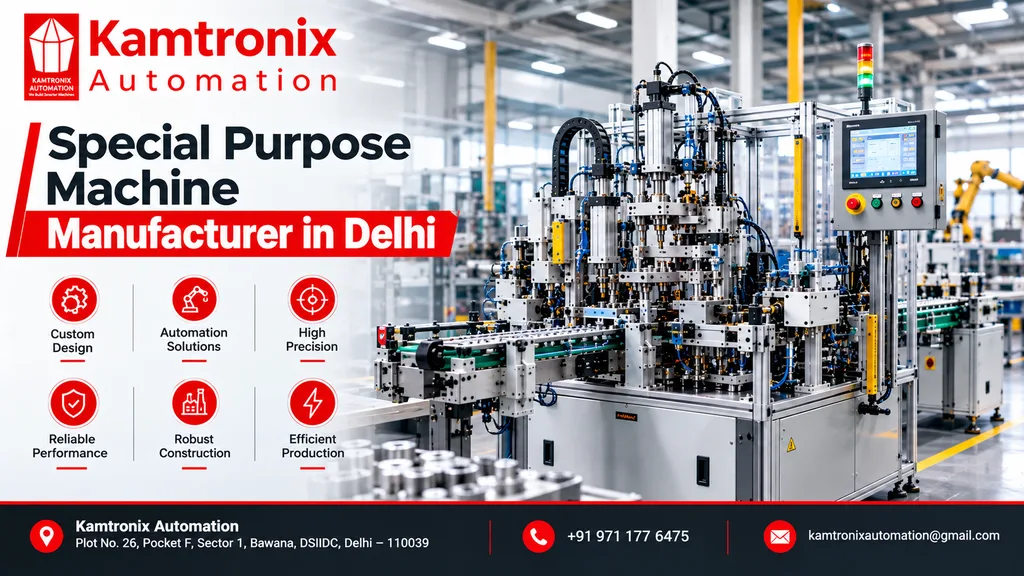
If you are looking for a Special Purpose Machine Manufacturer in Delhi, the requirement is usually a machine designed around a specific production operation rather than standard equipment. SPMs can be developed for assembly, pressing, drilling, feeding, testing, cutting, bending, loading, unloading, or inspection.
Kamtronix Automation provides customized automation and Special Purpose Machine solutions for industrial applications, developing machinery around customer requirements, production processes, tooling needs, cycle time, and process control.
What Is a Special Purpose Machine?
A Special Purpose Machine is designed for one particular manufacturing operation or a defined group of operations. Unlike general-purpose machinery, an SPM is developed around the product, process, tooling, fixtures, and cycle time.
For repetitive manufacturing, an SPM can integrate mechanical systems, fixtures, sensors, pneumatic components, electrical controls, PLC-based sequencing, servo systems, robotics, or other technologies depending on the application.
Which Types of Special Purpose Machines Are Available?
- Assembly Machines
Assembly machines support repetitive component joining, positioning, pressing, or loading operations. Automated fixtures and controlled sequences can improve repeatability. - Pressing and Feeding Machines
A Special Purpose Machine Manufacturer in Delhi can combine feeding and pressing where both operations form one production sequence. Pressing systems can be developed where components need controlled force and positioning. - Drilling Machines
Multi-drilling machines can perform multiple drilling operations according to component design and tooling arrangement. The concept depends on hole positions, geometry, volume, and cycle time. - Testing Machines
A Special Purpose Machine Manufacturer in Delhi may develop testing equipment around the defined test method and production requirement. Kamtronix Automation lists torsion spring life-cycle, helical spring life-cycle, rim-lock, security-seal, and door-lock handle testing applications. - Robotics and Handling Automation
Robotic arm feeders and automated handling systems can support loading, unloading, feeding, transfer, and repetitive component movement where controlled material handling is required.
How Do You Choose the Right Special Purpose Machine?
Define the Production Operation
Identify exactly which operation needs automation. Assembly, drilling, pressing, testing, bending, feeding, and handling can require very different machine architectures.
Evaluate Cycle Time
Required cycle time affects machine design, tooling, stations, automation sequence, and component handling. Establish the target output before engineering begins.
Check Component and Tooling Requirements
Component dimensions, material, geometry, tolerances, fixtures, and tooling influence the machine concept. Accurate work holding supports repeatable positioning.
Consider Existing Equipment
When selecting a Special Purpose Machine Manufacturer in Delhi, discuss existing controls, conveyors, inspection systems, and equipment early.
If the machine must work with existing equipment, controls, conveyors, or inspection systems, define integration requirements during design.
Plan Safety and Maintenance
A Special Purpose Machine Manufacturer in Delhi should receive clear information about operator access, maintenance needs, and available floor space.
Which Special Purpose Machine Is Suitable for Different Applications?
| Application | Suitable Machine Approach | Main Consideration |
|---|---|---|
| Component assembly | Automated assembly machine | Fixtures and sequence |
| Repetitive pressing | Pneumatic or automated press | Force and positioning |
| Multiple holes | Multi-drilling machine | Tool layout and accuracy |
| Component feeding | SPM press feeder or robotic feeder | Feeding consistency |
| Product testing | Application-specific testing machine | Test method |
| Component movement | Robotic handling system | Payload and movement |
| Wire processing | Wire bending, inserting or cutting automation | Material and geometry |

How Is a Special Purpose Machine Developed?
A customized machine project starts with requirement analysis. The engineering team needs information about the component, material, operation, production quantity, cycle time, quality requirements, floor space, operator involvement, and existing equipment.
The process can include concept development, mechanical and electrical design, tooling, manufacturing, testing, installation, commissioning, and training.
For a Special Purpose Machine Manufacturer in Delhi, this structured approach is useful when the machine must be adapted to a specific production environment.
What Affects the Cost of a Special Purpose Machine?
Cost depends on application complexity. Important factors include operations, automation level, tooling, fixtures, sensors, PLC controls, pneumatic or servo systems, robotics, testing, machine size, and equipment integration.
Production volume and cycle time should be established before comparing quotations because they can influence the required machine configuration and automation level.
Special Purpose Machine Manufacturer in Delhi: Kamtronix Automation
Kamtronix Automation is based in Bawana, Delhi, with listed solutions covering customized automation and application-specific machinery. Its portfolio includes testing machines, SPM press feeders, robotic arm feeders, multi-drilling, CNC engraving, wire bending and inserting, strip cutting, and assembly machinery.
For manufacturers comparing a Special Purpose Machine Manufacturer in Delhi, the evaluation should focus on how well the proposed machine matches the production process. Requirement analysis, machine concept, tooling, controls, testing, installation, and commissioning are important parts of a customized SPM project.
Kamtronix Automation states that it designs and builds machines according to customer requirements, making process-specific engineering a central part of its automation approach. Clear drawings and production data can make early machine discussions more precise and practical before detailed engineering begins.
Conclusion
A Special Purpose Machine Manufacturer in Delhi should be selected according to the manufacturing problem it needs to solve. Process type, cycle time, tooling, automation level, safety, integration, maintenance, and production volume influence the final design.
For businesses seeking a Special Purpose Machine Manufacturer in Delhi, Kamtronix Automation offers customized automation and SPM solutions based on stated customer requirements. A clear technical brief helps evaluate the right machine configuration and automation approach.

No Comments