
23 Sep Factory Automation Equipment: Smarter Manufacturing with Kamtronix Automation
Introdution
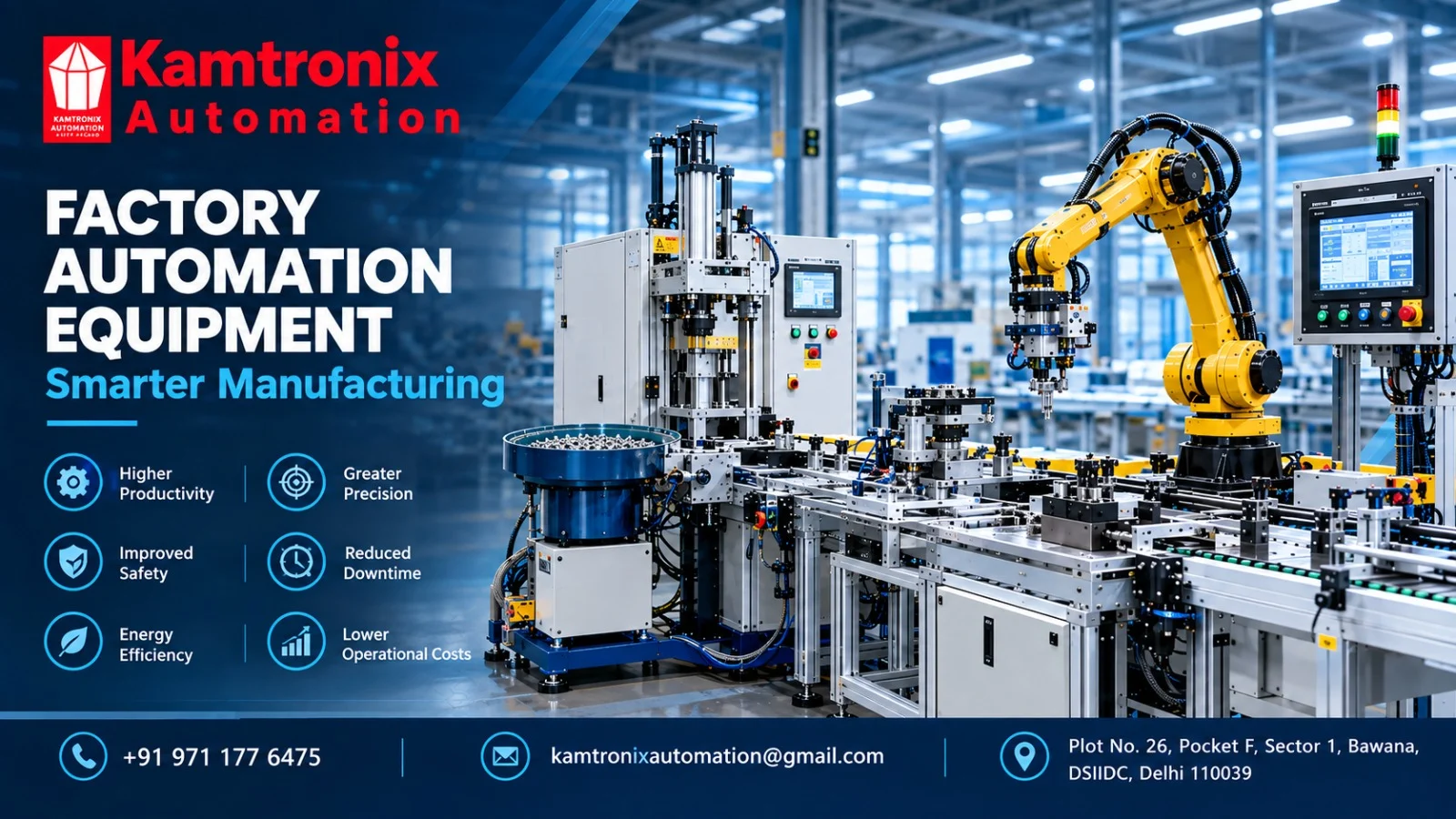
Manufacturing focuses on increasing productivity, maintaining consistent quality, reducing repetitive work and creating safer manufacturing conditions. Factory Automation Equipment is being used more and more to support repeatable production, while maintaining practical control over manufacturing operations. Instead of depending entirely on manual handling, manufacturers can use integrated systems for repetitive tasks with more consistency and process control.
Kamtronix Automation designs and builds custom automation machinery and Special Purpose Machines (SPMs) for industrial applications. Solutions range from production activities such as assembly, testing, pressing, drilling, feeding, cutting, bending, component handling and other dedicated manufacturing processes. The aim is to build machinery around a particular production requirement rather than trying to fit all applications into a standard machine.
What is Industrial Automation?
Factory Automation Equipment is the name given to machines, control systems, sensors, robotics and other technologies that are used to perform manufacturing activities with minimal human involvement. Factory automation is the application of machines to sense a component, locate it, perform an operation, inspect the result and transfer the finished component to the next stage.
It is particularly beneficial where a production process demands repeatability, controlled cycle times, standardised movements or consistent handling.
Benefits of Factory Automation
- Increased Production Efficiency
Factory Automation Equipment is able to do repetitive tasks following programmed sequences. This allows manufacturers to organise their production cycles and cut out unnecessary manual steps. Dedicated automation is especially helpful in high-volume processes where the same operation needs to be performed consistently throughout an entire shift. - Quality You Can Trust
Automation allows for the standardisation of movements, positioning, force, timing and other process parameters. Where a machine is used to carry out a defined operation in the same programmed way, manufacturers can reduce the variations associated with manual handling and improve process repeatability. - Less Repetitive Work
Automated machinery can do such things as pressing, drilling, feeding, cutting, tightening, assembling, testing and transferring parts. Operators can then spend their time on supervision, setup, inspection, maintenance and process management rather than doing every single production action over and over again. - Improved Process Control
Factory Automation Equipment can link sensors and programmable controllers to monitor the condition of a machine and to coordinate different stages of a production cycle. Using sensors and PLC-based control, the field devices can send signals and turn on outputs according to programmed logic, creating an organised and traceable machine sequence. - Help With Workplace Safety
Properly designed automation will reduce the direct contact of the operator with repetitive, pressing, cutting or handling operations. Machine guarding, interlocks, emergency stops, controls and proper risk assessment remain critical elements of a safe automation design.
Automation Solutions Types
- Machines for Special Use
SPMs are created for particular manufacturing operations. A customised SPM can perform a dedicated task by including tooling, fixtures, sensors, automatic clamping, pneumatic or electric mechanisms, and control logic. - Kamtronix Automation provides Special Purpose Machines for applications where standard equipment may not be able to provide the required process, cycle or component handling.
- Automatic Assembly Systems
Automated assembly systems integrate feeding mechanisms, fixtures, sensors, actuators and controls to assemble or place components in a pre-defined sequence. They can be designed for products with repeatable assembly needs and can incorporate inspection or rejection features. - Automation by Robots
Robots are helping in feeding, loading, unloading, handling of materials and assembly. A robotic feeder can move components between defined locations and communicate with surrounding equipment. - Pneumatics Automation
Pneumatic systems use compressed air to create controlled movement and are commonly found in applications such as pressing, clamping, pushing, feeding and positioning. - Automation Testing
Automated testing systems can standardise inspection and performance checks. Machines are available for lock testing, spring life-cycle testing, load testing and other defined procedures depending on the application. - CNC and Machining Automation
CNC-based systems allow programmable control of machining operations. Automation can help with loading, unloading, drilling, engraving, grinding and other component processes. Kamtronix Automation also develops CNC-related and customised machinery for industrial applications.
Main Elements
An automation system is composed of many different elements. Sensors detect the presence, position, proximity, pressure or other condition of parts. PLC controllers process input signals and drive outputs based on programmed logic. Pneumatic cylinders, motors or servo mechanisms act as actuators to create physical motion.
HMIs, drives, motion-control systems, fixtures, tooling, guarding, interlocks and emergency stops also contribute to a properly engineered automation system.
Industrial Applications
Factory Automation Equipment is suitable for automotive, electrical hardware, motor, glass, appliance, security product, bearing, toy and general manufacturing operations. The combination of feeding, assembly, pressing, testing, cutting, drilling, bending or inspection technologies varies by industry.
Selecting the Appropriate Automation Solution
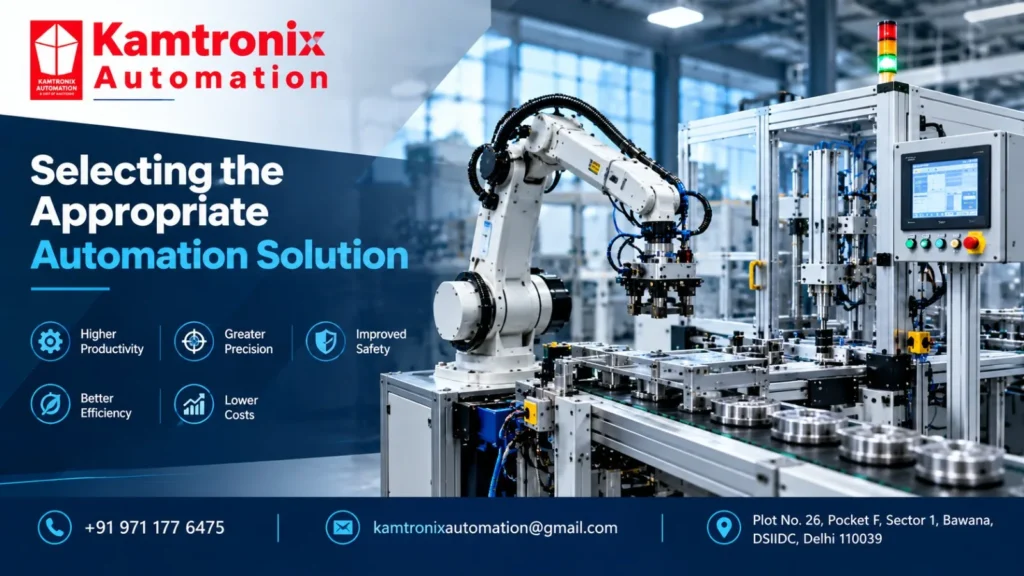
Factory Automation Equipment should be selected according to the manufacturing process. First, determine the specific task you want to automate. Then assess production volume, cycle time, component dimensions, material, weight, accuracy, repeatability and quality requirements.
Available factory space, operator access, material flow, electrical connections, pneumatic supply and maintenance access should also be considered. Integration with existing equipment, conveyors, robots, sensors or control systems is equally important.
Why Kamtronix Automation?
Kamtronix Automation develops Custom Industrial Automation Machinery and Special Purpose Machines according to specific customer requirements. The company offers solutions for various production applications and focuses on developing machinery around specific manufacturing processes.
Published solutions include SPM systems, robotic feeders, pneumatic presses, drilling and assembly machinery, testing machines, CNC-related equipment, wire-processing systems and special automation.
The value of automation for a manufacturer depends on how well the machine meets the actual production requirement. Repeatability, practical controls, safety provisions, maintainability and compatibility with the surrounding production environment are important considerations.
The Future of Automation in Manufacturing
Factory automation can range from a single automated workstation to an integrated production system. The best place to start is by identifying a measurable production problem, defining the required process parameters and designing the machine around those requirements.
Factory Automation Equipment can offer Indian manufacturers a practical route to better consistency, more controlled production and less repetitive work. Kamtronix Automation supports manufacturers looking for automation solutions designed specifically around their production processes.
No Comments