 Skip to content
07 Sep Industrial Automation Solutions for Modern Manufacturing
Industrial Automation Solutions: Transforming Modern Manufacturing and Industry
Modern manufacturing is moving toward smarter, faster, and more connected production. Industrial Automation Solutions help businesses automate repetitive operations, improve consistency, reduce production delays, and maintain better control over manufacturing processes.
From assembly and material handling to inspection and testing, automation allows industries to achieve higher productivity while maintaining quality and operational efficiency.
What Are Industrial Automation Solutions?
Industrial Automation Solutions combine machines, control systems, sensors, software, robotics, and communication technologies to operate industrial processes with limited manual intervention. These systems can be designed for a single operation or integrated across an entire production line.
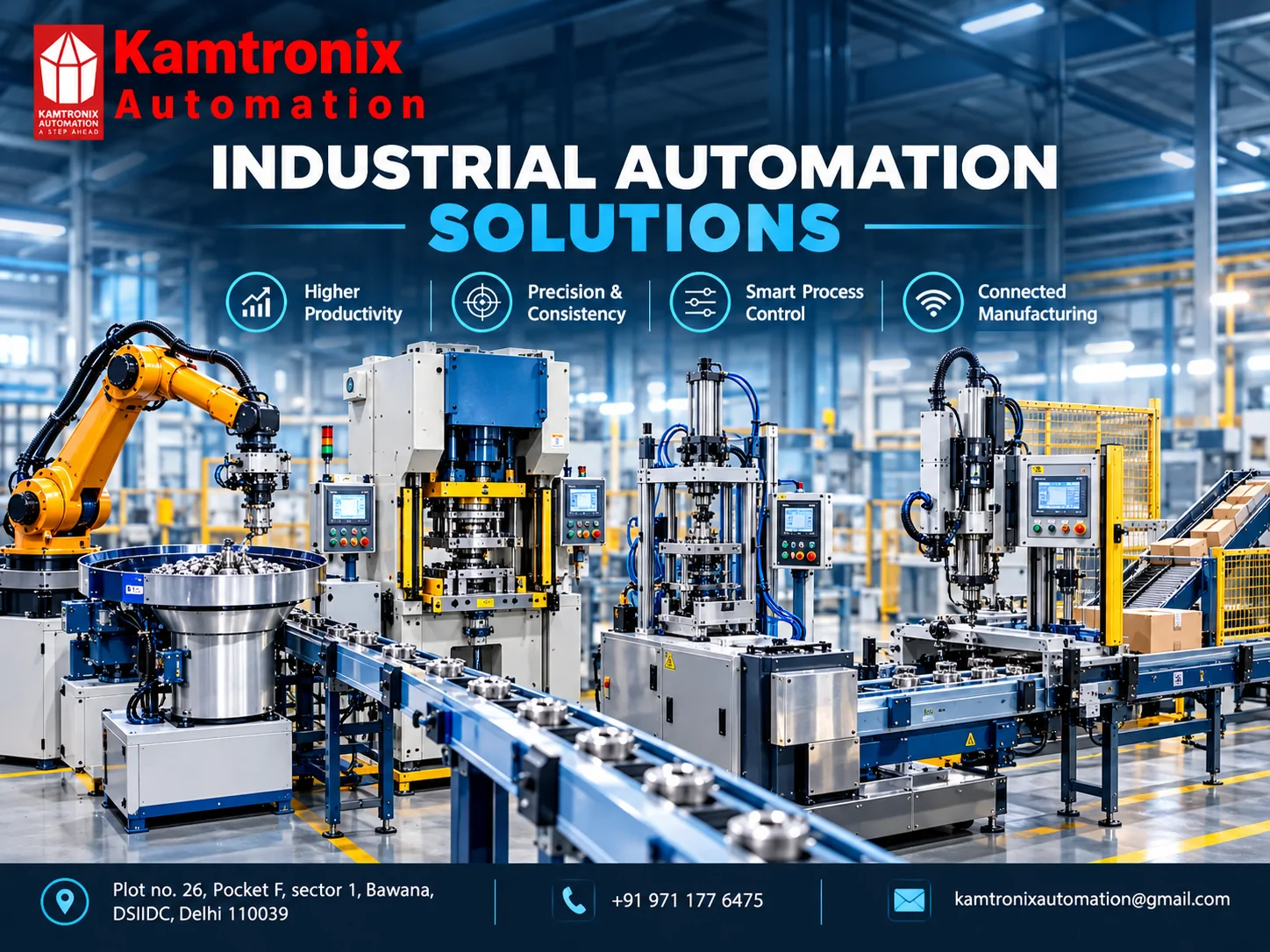
Automation may include programmable logic controllers (PLCs), human-machine interfaces (HMIs), servo systems, pneumatic equipment, robotic arms, vision systems, conveyors, and specialized machines. The right combination depends on production requirements, product design, cycle time, accuracy, and the level of automation required.
Why Industrial Automation Matters
Machines do the same thing over and over at uniform speeds and intervals. This is particularly useful in operations such as assembly, pressing, feeding, inspection, drilling, testing, sorting and packaging.
Automation can also help to improve safety at work by removing the need for people to be directly involved in dangerous or physically demanding processes.
Key Components of Automation
A successful automation system depends on properly coordinated hardware and software. The major components include:
- Sensors: Collect information such as position, temperature, pressure, speed, and product presence.
- Controllers: Process input signals from sensors and send commands to machines and actuators.
- PLCs (Programmable Logic Controllers): Control machine sequences, operations, and automated processes.
- HMIs (Human-Machine Interfaces): Allow operators to monitor production, view machine status, and adjust settings.
- Servo Motors: Provide precise and controlled movement for high-accuracy applications.
- Pneumatic Systems: Deliver fast and reliable mechanical action for various industrial operations.
- Industrial Networks: Connect machines, controllers, and other devices to enable efficient communication and production-data monitoring.
Robotics and Special Purpose Machines
Special purpose machines are another important part of the automation.
These machines are customised for particular manufacturing needs like component assembly, testing, pressing, feeding, cutting or inspection. Custom automation can deliver cycle times and process sequences that standard equipment may not be able to achieve.
Benefits for Manufacturing
Industrial Automation Solutions can deliver several operational benefits. Higher machine utilization can increase production output, while controlled processes can improve product consistency. Automated inspection and testing can identify defects earlier, reducing waste and rework.
Automation also creates better process visibility. Production parameters, machine status, alarms, and performance information can be monitored through control interfaces. This data can support maintenance planning and help production teams identify recurring problems.
Industrial IoT and Smart Manufacturing
Manufacturers can use connected data to track machine performance, monitor energy consumption, analyze downtime, and improve production planning. When automation systems are connected with data platforms, businesses can make decisions based on actual operating conditions rather than assumptions.
Applications Across Industries
Automation is used across automotive, electronics, electrical, pharmaceutical, food and beverage, packaging, consumer goods, and general engineering industries.
Applications include assembly lines, component handling, quality inspection, material feeding, machine loading, testing, packaging, and production monitoring.For high-volume manufacturing, automation can provide repeatable cycle times and reliable process control. For customized production, flexible systems can be configured to handle different products or operating sequences.

Choosing the Right Automation System
Selecting an automation system requires a clear understanding of the manufacturing process. Businesses should evaluate production volume, product dimensions, required cycle time, accuracy, available floor space, safety requirements, and future expansion plans.
It is also important to consider integration with existing machinery. A well-designed system should communicate effectively with current equipment and provide operators with practical controls. Service support, spare parts, maintenance requirements, and operator training should also be considered before implementation.
Challenges and Implementation
Automation requires investment in equipment, engineering, installation, programming, and training. Poorly planned automation can create integration problems or fail to deliver the expected return.
A structured implementation process can reduce these risks. Manufacturers should begin with process analysis, define measurable objectives, select appropriate technologies, test the system, and train operators before full-scale deployment. Regular maintenance and performance monitoring are also essential for long-term reliability.
The Future of Manufacturing Automation
Robotics, connected machines, intelligent software, machine vision, data analytics and flexible control systems will become increasingly part of the future of manufacturing. Companies are moving to production environments where machines can exchange information and react more effectively to changing needs.
Industrial Automation Solutions provide a practical base for manufacturers trying to update production to get more productivity, consistency, safety and process visibility. Automation, when engineered and integrated properly, can change complicated manufacturing operations into more controlled, measurable and efficient processes.
Conclusion
Industrial automation is not just for big factories. Automation can be adopted according to the production requirements and budgets of different sizes of businesses. Whether it’s a single special purpose machine or a connected production line, the right system can boost efficiency and give you a better foundation for future growth.
Kamtronix Automation specialises in providing custom building automation systems for industry. The company brings together engineering, machine automation, control systems and custom manufacturing techniques to allow businesses to run smarter, more reliable production.
Industrial Automation Solutions improve control. Industrial Automation Solutions support scaling. Industrial Automation Solutions enhance reliability. Industrial Automation Solutions strengthen efficiency.

No Comments